Reaction Time Game – Test Your Reflexes Online
Click the moment the screen turns green. Free, no signup, unlimited plays.
Best
—
Average
—
Plays
0
Try More Reaction Time Games
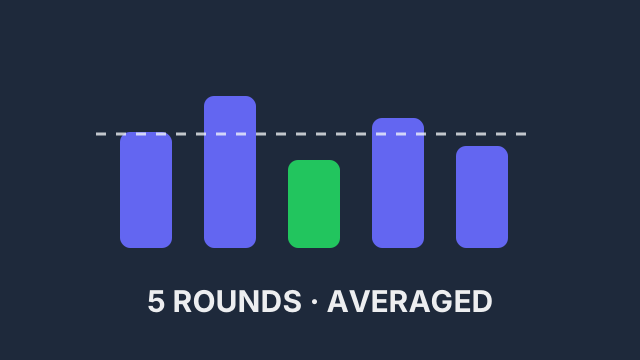
Reaction Time Test
Five measured rounds, averaged into one score you can compare against global data.
Play →
Reaction Speed Test
Endless mode. Hit every green in a row and see how long your streak survives.
Play →
1v1 Multiplayer Battle
Two players, one screen, first to five points. Settle it with a friend.
Battle →What Is a Reaction Time Game?
A reaction time game measures the gap between a stimulus appearing and your body responding to it. That is the whole idea behind every reaction time game on this site, and this is the simplest reaction time game of the set. In this game the stimulus is a color change: the panel sits red for an unpredictable moment, flips to green, and the clock starts. It stops the instant you click. What is left on the timer is your simple visual reaction time, measured in milliseconds.
That number is not just a game score. It is made up of three real stages — light hitting your retina and traveling to the visual cortex, your brain deciding that the signal matters, and the motor command reaching the muscles in your hand. Nerve conduction alone accounts for well over a hundred milliseconds, which is why nobody scores near zero. A score under 150ms almost always means you clicked on a guess rather than on the signal.
You will see two different averages quoted around the web, and both are correct. Laboratory studies of simple visual reaction time put the adult average near 250ms, using purpose-built hardware that introduces almost no delay of its own. Large browser-based data sets put it closer to 273ms, because a web page cannot subtract the time your monitor takes to draw the new frame or your mouse takes to report the click. That 20 to 30 millisecond gap is equipment, not biology. This site ranks you against the 273ms figure, since it was gathered the same way your score is — comparing a browser result to a laboratory average would quietly make everyone look slower than they are.
How to Play
Every round of the reaction time game runs the same way. Click the panel once to arm it. Wait while it is red — the delay is randomized between one and three seconds so there is no rhythm to memorise. As soon as it turns green, click or press the space bar. If you click while the panel is still red the attempt is voided and you start that round again, which keeps anticipation from inflating your score.
Your best reaction time, running average, and total plays are kept in your own browser, so you can come back tomorrow and see whether practice actually moved the number. Nothing is uploaded and no account is needed.
Reaction Time Game vs. Reaction Time Test – What Is the Difference?
People search for both, and they usually want slightly different things. A reaction time game like this one is the quick version: one click, one number, a rating, and the freedom to go again immediately. It is built to be fun and slightly competitive, which is why this page gives you a rating and a personal best rather than a clinical readout. Most players open it, take ten shots at beating themselves, and leave.
A reaction time test is the careful version. A single attempt is a noisy measurement — blink at the wrong moment, or get lucky with an anticipated click, and the number swings by 40 or 50 milliseconds in either direction. Averaging several rounds cancels most of that noise out, which is why any score you intend to actually compare against other people should come from a multi-round measurement rather than one lucky click.
The practical rule: play the game when you want a fast answer or a rematch with a friend, and run the test when you want a number worth quoting. For a more scientific measurement, try our five-round reaction time test, which averages five attempts and shows where your reaction time sits against the population. If you would rather measure endurance than a single reaction, the reaction speed test runs until you finally miss one.
How to Improve Your Reaction Time Game Score
Reaction time is trainable, but the gains come from a handful of unglamorous places. Short daily sessions of ten to twenty attempts beat one long session a week. Keeping your hand loose and hovering rather than pressed down removes wasted movement. Sleep matters more than most people expect — a night of poor sleep routinely costs 30 to 50 milliseconds, which is larger than the improvement most players gain from weeks of practice.
Equipment is worth checking too. A 60Hz display adds around 8ms of unavoidable delay compared to a 144Hz one, and wireless peripherals with power saving enabled can add more. If you want the specific exercises and the evidence behind them, read the reaction time training guide, then measure your progress properly with the five-round test.
A Free, Unlimited Reaction Time Game
There is no paywall, no sign-up wall, and no cap on attempts. The game runs entirely in your browser and works on desktop, tablet, and phone. Because your results live in local storage rather than on a server, clearing your browser data will reset your history — and nothing about your play leaves your device.
One caveat worth knowing before you compare scores with anyone: the device is part of the measurement. A phone touchscreen adds roughly 20 to 60 milliseconds of input latency that a mouse click does not, and a 60Hz screen adds several more than a 144Hz one. None of that is your nervous system, but all of it lands in the number. Compare reaction time results measured on the same kind of hardware, or the comparison is really about the hardware.
If you want a fuller picture, the full collection of reaction games covers every mode on the site, from the single-click game to the head-to-head 1v1 reaction battle.
Frequently Asked Questions
What is the average human reaction time?
It depends on how it was measured. In a laboratory, adult simple visual reaction time averages around 250 milliseconds. Measured in a browser, the same population averages closer to 273 milliseconds, because a web page cannot subtract the delay added by your monitor's refresh cycle and your mouse or touchscreen. Both figures describe the same reflexes; the 20 to 30 millisecond gap is equipment, not biology. This site ranks you against 273ms, since that is measured the same way your score is. Either way, most people land between 200ms and 300ms, and times under 150ms usually mean you anticipated the signal rather than reacted to it.
Is this reaction time game free?
Yes. Every game on ReactionTiming is completely free, with no account, no download, and no limit on how many times you can play. Your scores are stored privately in your own browser.
How can I improve my reaction time game score?
Consistent short practice sessions help more than long ones. Play a few rounds daily, keep your hand relaxed rather than tense, use a wired mouse or a device with a high refresh rate, and pay attention to sleep — being tired can add 30 to 50 milliseconds to your score. Our training guide walks through five exercises in detail.
Why is my reaction time slower on a phone than a computer?
Touchscreens add input latency that a mouse click does not, typically 20 to 60 milliseconds depending on the device. That difference is in the hardware, not in you, so only compare scores measured on the same kind of device.
What counts as a good reaction time game score?
Under 273ms puts you above the average score measured in a browser, which is the baseline this site ranks you against. Under 250ms would beat the average even under laboratory conditions, where the equipment adds no delay. Under 200ms is genuinely fast and is roughly where competitive gamers sit. Under 150ms is Formula 1 territory — professional drivers are tested around 150 to 200ms under race conditions.
Does clicking early count against me?
Clicking while the screen is still red voids that reaction time game attempt and shows a 'Too early' message. The random delay before the green signal exists precisely to stop you from timing the change instead of reacting to it.