Reaction Time Training – Practice Guide
What actually works in reaction time training, what does not, and five exercises you can start in the next two minutes.
Why Bother With Reaction Time Training?
A browser reaction game gives immediate feedback on one narrow task: responding to a visible signal with a key press or tap. Repeating it can help you notice when you anticipate the signal or lose focus.
Performance here does not establish how you will perform while driving, playing sport or responding to everyday hazards. Those activities involve decisions and movements that this game does not test.
5 Reaction Time Practice Ideas
Each reaction time training exercise below targets a different piece of the response, and each links to a tool on this site you can use for it. Go in order if you can — it runs from raw speed, to measurement, to attention and pressure, which is roughly the order people run out of ability.
1. Simple Reaction Time Training
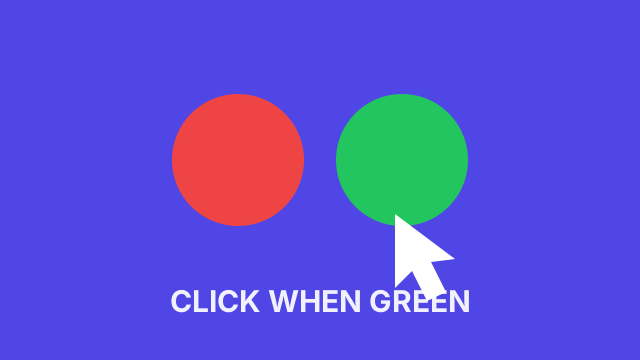
The foundation: a single stimulus, a single response, repeated until the movement is automatic. Do ten to fifteen attempts, focusing on keeping your hand relaxed and your eyes fixed on the center of the target rather than scanning. The goal is not a record score — it is reducing the variation between your fastest and slowest attempt, which is what consistent performance actually looks like.
Try it → Reaction Time Game2. Measured Baseline Testing
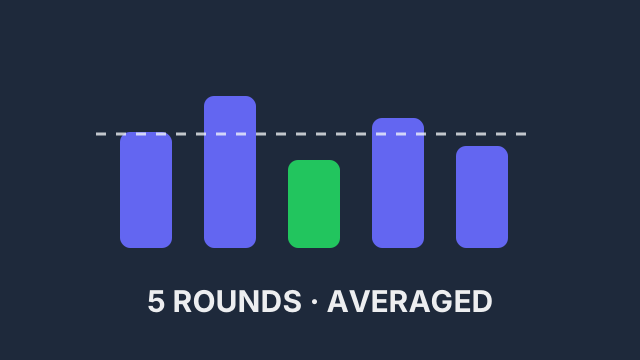
You cannot train what you do not measure, and a single attempt is too noisy to measure anything. Once or twice a week, take a five-round averaged test under consistent conditions — same device, same time of day, same caffeine state — and write the number down. A four-week trend line tells you far more than any individual score, and it is the only way to tell real improvement from a lucky click.
Try it → 5-Round Reaction Time Test3. Sustained Attention (Endurance) Training
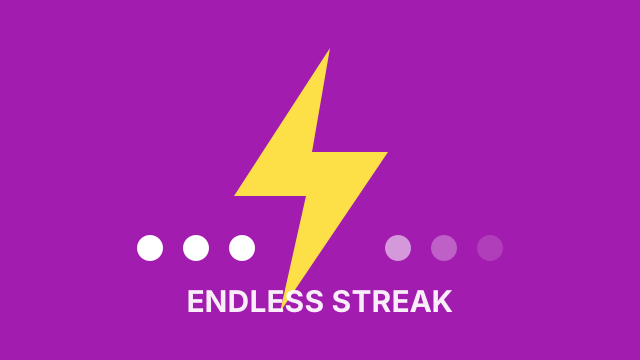
Most real-world failures are not slow reactions — they are missed signals. Endurance drills present stimuli continuously at unpredictable intervals so that lapses in vigilance, not slow hands, are what end the run. This is the closest browser analogue to the demands of driving or goalkeeping, and it is where most people find their weakness.
Try it → Reaction Speed Test4. Competitive Pressure Training
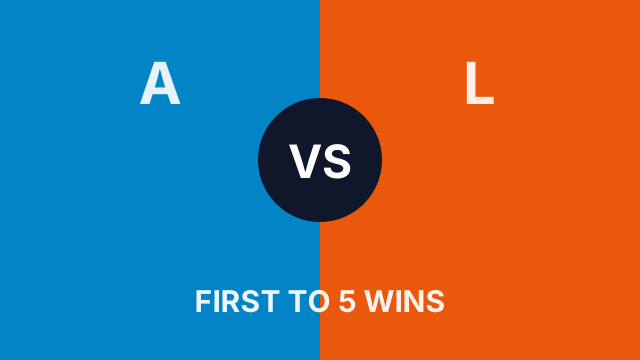
Performance under pressure is a separate skill from performance in isolation. Racing someone introduces the exact failure mode that matters — the urge to anticipate rather than react — and punishes it immediately. Ten minutes of head-to-head play teaches restraint far faster than solo practice, because the cost of guessing is visible on the scoreboard.
Challenge a friend → 1v1 Reaction Battle5. Lifestyle Habits That Move the Number
Keep a note of your device, input method and how focused you felt. Repeat under similar conditions and take breaks when you are tired. This page is a practice guide, not medical advice or a treatment plan.
Reaction Time by Age
This site does not have a validated age-specific dataset. We do not publish target milliseconds by age group or assume a fixed change per decade. Results depend on the task and setup, so an age table from another test would not automatically apply to this browser game.
Track your own repeated sessions with the same device and input method. The estimate on our five-round test uses an illustrative model; it is not age-adjusted and should not be used to assess health or ability.
A Four-Week Reaction Time Training Plan
Here is the whole reaction time training plan. Week one: take a baseline five-round test and record it, then do ten simple reaction attempts a day. Week two: add one endurance run per session and stop chasing your record — aim for consistency instead. Week three: introduce competitive rounds, which will expose any habit of anticipating. Week four: retest under the same conditions as week one and compare. Look for repeatable changes rather than expecting a guaranteed improvement. A flat result is useful information too.
After four weeks, decide whether this routine is useful to you. Keep the sessions short and compare both the average and the spread of results. Changing devices starts a new comparison; it is not evidence that your reactions suddenly improved or worsened.