Reaction Time Test
A five-round reaction time test, averaged into one score — the honest way to find your baseline.
Percentile estimates use an assumed normal distribution (mean 273 ms, standard deviation 50 ms), not measured player data or an age-adjusted norm. Display, browser and input delays are included in your score; compare sessions on the same setup. Ratings are playful labels, not assessments.
More Ways to Play

How Scientific Is This Reaction Time Test?
This test records the delay between a browser signal and your input. Five rounds give you a session average and a visible spread of results. A random waiting period makes it harder to predict the signal. It remains a game, not a validated scientific assessment.
Your score includes display, browser and input delays. The page cannot detect when a pixel physically changes or when your finger first moves. There is no fixed latency correction or guaranteed accuracy range. Use the same setup for repeat sessions and allow for day-to-day variation.
What Factors Affect Reaction Time?
This site has no validated age-specific reference data. We do not use age to predict your time or adjust the estimate. Attention, anticipation and testing conditions can change your results, so record the setup along with your scores.
Context matters too. You will be faster when you expect the signal soon, faster in the afternoon than immediately after waking, and faster when the stimulus is bright and central than when it is dim or peripheral. None of that makes the number unreliable — it just means you should run it under the same conditions each time. If you want to work on the parts you control, the training guide covers the specific drills, and the speed test is a good way to practice sustained attention.
What's a Good Reaction Time Test Score?
Start with your own previous sessions on the same setup. The percentile displayed here uses an assumed normal distribution with a mean of 273 ms and a standard deviation of 50 ms. Those numbers are model settings, not a measured average or spread of our visitors.
The estimate tells you where your session sits in that model. It does not show how many real players you beat, establish an age norm, or compare you with professional athletes. Changing the assumptions would change the percentage even if your measured time stayed the same.
But the number by itself matters way less than where it sits next to your own history. A 265ms average sounds forgettable — unless it was 295ms on the same laptop last month, in which case you actually got better. Flip it around: a great-looking 210ms means nothing if it came from one lucky session you never repeated. Take the test on a few different days before you decide what your score really is.
Reaction Time Test vs. Simple Reaction Game
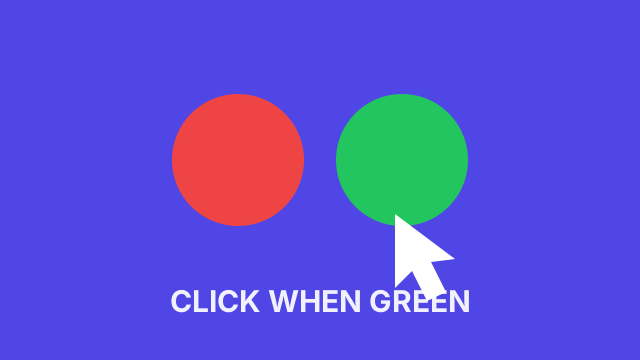
This page and the reaction time game measure the same thing but answer different questions. The game is one click — screen goes green, you react, you get a number and a rating in about ten seconds. It's a game first and a reaction time test second, built for curiosity and for spamming. Play it twenty times while you're waiting on a build and you'll have a pretty good feel for your range.
This test is built for a number you can actually defend. Five rounds under identical conditions, early clicks void the round and make you redo it instead of quietly padding your average, and you get a per-round breakdown at the end. That breakdown is the good part: it shows whether your average came from five steady trials or from three solid ones and two train wrecks. A single-click game can't tell you that, and it's usually the more interesting half of the story.
Rule of thumb — play the game to warm up or scratch an itch, take the reaction time test when you want to write something down. If you're tracking yourself over a few weeks, a five-round average under consistent conditions is the only version of the number that's worth recording.
How to Read Your Reaction Time Test Score
Review both your average and your individual rounds. A very short response may reflect anticipation; a slower round may reflect a pause or distraction. Repeat the session before drawing conclusions. The playful rating labels do not diagnose ability, fitness or health.
The most useful habit is running your reaction time test under the same conditions each time: same device, same time of day, same level of caffeine. That turns a one-off number into a trend you can actually act on.
Frequently Asked Questions
How scientific is this reaction time test?
This is a browser reaction game, not a validated scientific or clinical assessment. It averages five responses to a visual signal. Display, browser and input delays are included, and we cannot provide a calibrated error range. Compare sessions on the same device and input method.
Why does the reaction time test use five rounds instead of one?
Five trials let you see variation between attempts and reduce the influence of one unusually fast or slow response. The average is a summary of this session, not a fixed measure of your ability.
What factors affect reaction time?
Attention, anticipation and testing conditions can change your session. Display refresh rate, browser scheduling and your mouse, keyboard or touchscreen also affect the recorded time. This site cannot separate these effects.
What happens if I click too early?
That round is voided and repeated, so an early click can never flatter your reaction time test average. Because the delay before the green signal is randomized between one and four seconds, guessing is a losing strategy — you cannot learn the rhythm.
How is the percentile calculated?
We compare your average with an assumed normal distribution: mean 273ms and standard deviation 50ms. These are illustrative model settings, not a dataset collected from players or a validated population norm. The percentage is an estimate of simulated times slower than yours, not your rank among people.
Is my reaction time test result saved anywhere?
Only in your own browser's local storage. There is no account, no server-side record, and nothing is shared unless you copy your result yourself.