Reaction Speed Test
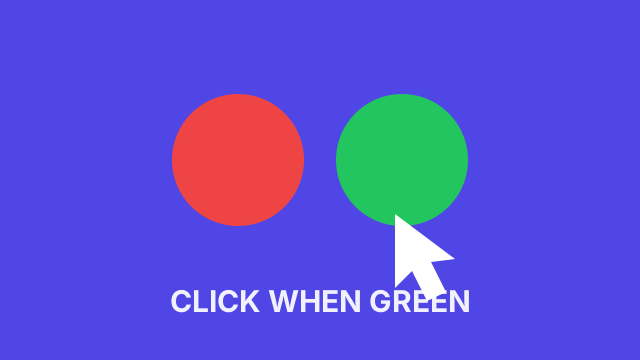
An endless reaction speed test. Hit every green in a row — one miss and the run is over.
Streak
0
Best Streak
0
Avg Speed
—
More Reaction Games
What the Reaction Speed Test Actually Measures
A single reaction test tells you how fast you can respond once. This reaction speed test tells you how long you can keep doing it. Signals arrive continuously with gaps of half a second to two seconds, and a run ends on the first miss or the first early click. That combination turns it into a test of vigilance — the ability to hold a low-effort, high-alert state without either drifting off or over-anticipating.
It is the same skill a goalkeeper uses across ninety minutes or a driver uses on a long motorway stretch: nothing happens for a while, then something happens instantly and there is no time to reacquire focus. Most players discover that their raw speed is fine and their attention is what fails.
Reaction Speed Test vs. Reaction Time Test
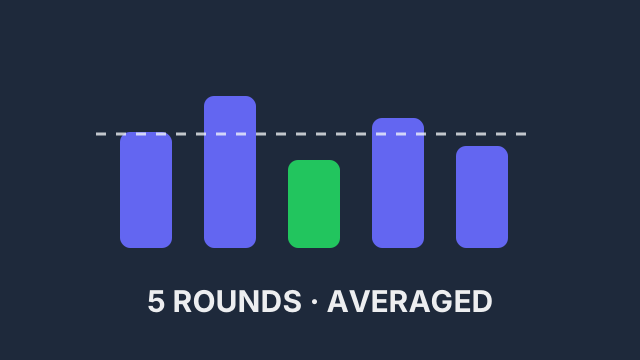
People use the two names interchangeably, but they're really measuring different things. A reaction time test isolates one response: single signal, single press, repeated a few times and averaged into a millisecond number. A reaction speed test like this one asks how well that response survives being repeated over and over, with zero warning about the next signal and no breather in between.
You can see the difference in what trips each one up. The five-round reaction time test cares about your hardware, your posture, and whether you were dialed in for those ten seconds — it rewards a clean setup and a moment of focus. This one cares about attention, full stop. Your fastest hit deep into a run is usually just as quick as anything you'd post solo, and the run ends anyway, because somewhere around signal thirty your focus drifts a couple of percent and that's all it takes.
So it comes down to what you're asking. If someone wants to know your reaction time, they mean the averaged number, and the five-round test is the tool. If you want to know whether you'll still get it right on the fiftieth signal — the version that actually matters behind the wheel or in goal — the streak tells you more.
How Streak-Based Reaction Speed Tests Work
A streak-based reaction speed test works by taking away the thing that makes one-off tests so flattering: time to get ready. In a five-round test you know a signal's coming and you get a countdown to collect yourself. Not here. The gaps are randomized between half a second and two seconds, and they just keep coming, so there's never a moment to reset. What you're stuck holding is a relaxed-but-alert state, and your score is basically a measure of how long you can hold it.
Two things end almost every run, and they pull in opposite directions. First is your attention wearing down — vigilance on a repetitive watching task measurably decays within a few minutes, and you fumble a signal you'd have caught easily on round three. Second is anticipation. The gaps are short enough that your brain decides there's a rhythm and starts firing on the beat instead of on the color change. That reads as an early click, and it kills the run just as fast as a miss does.
Which is why streak length predicts real-world performance better than a raw average does, and why your numbers tend to get worse over a long session instead of better. Fatigue piles up faster than familiarity. Five focused runs will teach you more about your reaction speed than half an hour of grinding, and if your streaks are dying early on a day when your solo average looks normal, it's almost always sleep.
Worth knowing before you start: that one-second response window is generous on purpose. It's roughly four times a normal reaction time, so when you miss a green, it's essentially never because you were too slow. It's because you didn't see it. When a run ends on a miss instead of an early click, what failed was your attention — and trying harder to be fast won't fix that.
Strategy: How to Build a Long Streak
The single biggest improvement on a reaction speed test comes from resisting rhythm. The gaps are random, but your brain will insist on finding a pattern and start clicking on the beat instead of on the signal. Once that happens the run usually ends within a few rounds. Keep your eyes on the center of the panel and let the color change trigger you rather than trying to predict when it is due.
Physically, treat the reaction speed test like any other timed task: rest your finger lightly on the mouse button rather than pressing into it — tension slows the release. Blink deliberately between signals instead of staring, since a forced blink at the wrong moment costs a whole round. And stop while you are ahead: streak attempts get worse as fatigue accumulates, so five focused runs beat twenty tired ones.
Where to Go Next
If your streaks on this reaction speed test are long but your hits feel slow, take the five-round reaction time test to get a clean baseline number. If you want to work on the underlying ability rather than the score, the training guide has five exercises and the evidence behind each one. And when you want to find out whose reflexes are actually better, settle it in the 1v1 battle.
Frequently Asked Questions
How is the reaction speed test different from the standard test?
The standard test measures a single clean reaction five times and averages it. This one never stops: greens keep coming with short random gaps, and the run ends the moment you miss one or jump early. It measures sustained attention as much as raw speed.
How long do I have to hit each green?
One second. That is generous compared to your actual reaction time, so misses almost always come from attention drifting rather than from being slow.
What is a good streak on the reaction speed test?
Fifteen is solid, thirty is genuinely good, and fifty or more puts you in the top bracket. Most people fail somewhere between eight and twenty on their first few runs, usually because the short gaps between signals make it tempting to click on rhythm.
Why do I keep clicking too early?
The gaps are randomized between half a second and two seconds, which is short enough that your brain starts predicting. The fix is counterintuitive: stop trying to be fast and just watch the panel. Anticipation ends more runs than slow hands do.
Does the reaction speed test save my best streak?
Yes, in your browser's local storage. It survives closing the tab but is cleared if you wipe your browser data, and it is never sent anywhere.
Does this work on mobile?
Yes. Tap instead of click. Expect slightly worse average times than on a desktop because touchscreens add input latency, though your streak length is barely affected since the one-second window is comfortably wide.